
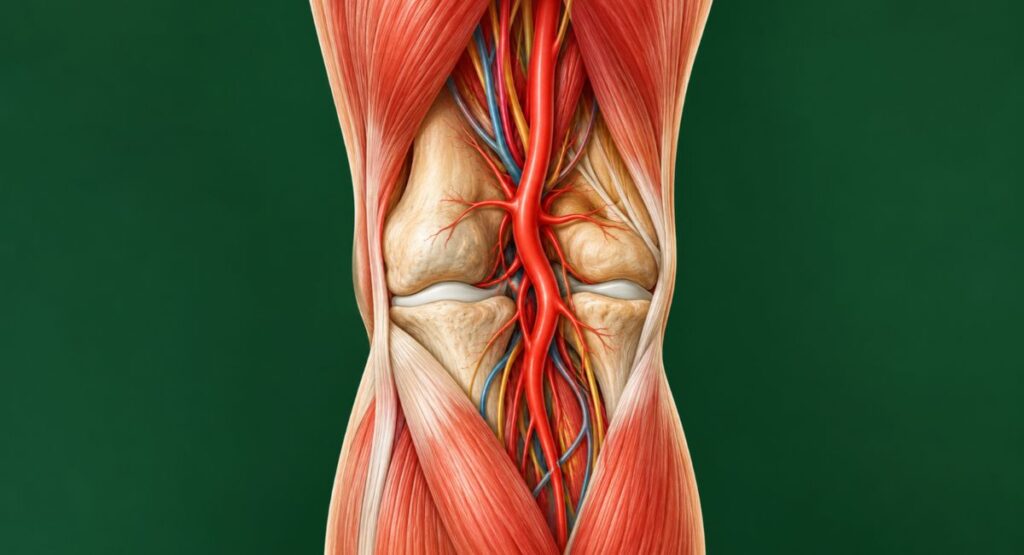
The popliteal pulse location is behind the knee, in an area called the popliteal fossa. It is the pulse produced by blood flowing through the popliteal artery, a major blood vessel that supplies the lower leg.
To locate it, gently feel the deeper central area behind your knee while keeping the knee slightly bent. Unlike the wrist pulse, the popliteal pulse can be difficult to detect because the artery lies relatively deep beneath surrounding tissues.
Understanding its location, anatomical structure and relationship with the heartbeat helps explain why healthcare professionals examine this pulse during physical assessments.
Where Is the Popliteal Pulse Located?
The popliteal pulse is found in the popliteal fossa, which is the hollow area behind the knee joint.
This area contains several important anatomical structures, including:
- The popliteal artery.
- The popliteal vein.
- The tibial nerve.
- Surrounding muscles and connective tissues.
The popliteal artery is located deeper than some other structures in this region. This is one reason why finding its pulse can be more challenging than feeling the radial pulse at the wrist.
The artery begins as a continuation of the femoral artery after it passes through the adductor hiatus in the thigh. It travels behind the knee and eventually divides into the arteries supplying the lower leg.
How Do You Find the Popliteal Pulse?
Finding the popliteal pulse requires a slightly different approach from checking the pulse at the wrist.
The following steps explain the basic anatomical palpation technique:
- Sit or lie in a comfortable position.
- Keep your knee slightly bent to relax the surrounding muscles.
- Place your fingertips in the central hollow behind your knee.
- Apply gentle, steady pressure using your fingertips.
- Allow a moment to identify the rhythmic pulsation.
The artery is relatively deep, so the pulse may not be immediately noticeable.
Healthcare professionals may use different patient positions during examination, including lying face down or lying on the back with the knee bent.
Important: Avoid pressing excessively hard. The aim is to identify the arterial pulsation through gentle palpation, not to apply force to the back of the knee.
Why Is the Popliteal Pulse Difficult to Feel?
The popliteal pulse is often more difficult to locate than pulses at the wrist or neck.
There are several anatomical reasons for this:
1. Deep artery location
The popliteal artery lies relatively deep within the popliteal fossa. Its depth makes the pulsation harder to detect through the skin.
2. Surrounding anatomical structures
Muscles, connective tissues, veins and nerves occupy the area behind the knee. These structures make the examination more challenging.
3. Knee positioning
The position of the knee can affect the accessibility of the artery during palpation. Keeping the surrounding muscles relaxed can make the examination easier.
4. Individual anatomical differences
Body structure and the amount of surrounding soft tissue can influence how easily the pulse can be felt.
Therefore, difficulty locating this pulse does not automatically indicate a circulation problem.
Why Can I Feel My Popliteal Pulse?
Feeling a pulse behind the knee is generally consistent with normal arterial activity.
Every time the heart contracts, it pushes blood into the arteries. This creates a pressure wave that travels through the arterial system.
The popliteal artery carries this blood towards the lower leg. Its rhythmic expansion produces the popliteal pulse.
The pulse may become more noticeable depending on body position, physical activity and individual anatomy.
However, feeling a pulse does not independently confirm that the artery is completely healthy.
A persistent unusual pulsating lump or swelling behind the knee is different from simply feeling an arterial pulse and should not be interpreted through self-examination alone.
What Is the Normal Popliteal Pulse Rate?
There is no separate normal heart rate specifically for the popliteal artery.
The popliteal pulse generally follows the same rhythm and rate as the heartbeat because it reflects blood being pumped through the arterial circulation.
For most healthy adults, a commonly used reference range for resting heart rate is 60–100 beats per minute.
This is a general adult resting heart-rate reference, not a special range established for the popliteal pulse.
The measured rate can vary with physical activity, age, fitness, emotional state and other physiological factors.
Popliteal Pulse vs Other Pulse Points
The body has several locations where arterial pulsations can be examined. These locations are known as pulse points.
| Pulse point | Anatomical location |
| Radial pulse | Wrist, near the thumb |
| Carotid pulse | Side of the neck |
| Brachial pulse | Inner upper arm near the elbow |
| Femoral pulse | Groin region |
| Popliteal pulse | Behind the knee |
| Posterior tibial pulse | Behind the inner ankle |
| Dorsalis pedis pulse | Top of the foot |
The main difference between these pulse points is their anatomical location and the artery being examined.
The popliteal pulse is particularly relevant when examining arterial circulation in the lower extremity.
What Does the Popliteal Pulse Tell Us?
The popliteal pulse is one of the peripheral arterial pulses that healthcare professionals may assess during a physical examination.
Its presence, rhythm and strength can contribute to an assessment of blood circulation in the lower limb.
However, pulse palpation has limitations. A pulse examination alone cannot provide a complete assessment of arterial health or establish a diagnosis.
Healthcare professionals interpret physical examination findings alongside other relevant clinical information when assessing circulation.
Conclusion
The popliteal pulse is located deep within the hollow area behind the knee, where the popliteal artery travels towards the lower leg.
It can be examined through gentle palpation while the knee is relaxed and slightly bent. However, its deeper anatomical position makes it more difficult to detect than some other arterial pulses.
The popliteal pulse generally follows the same rate as the heartbeat, rather than having a separate normal rate.
Understanding its location and function provides a useful introduction to lower-limb anatomy and the way arterial pulses are examined.
References and source links
These are the five references you supplied. They are listed as candidate references, not as independently verified sources.
1. What Is Location Popliteal Pulse? — WebMD. Publication year not verified.
https://www.webmd.com/heart/what-is-location-popliteal-pulse
2. Popliteal Artery — Cleveland Clinic. Publication year not verified.
https://my.clevelandclinic.org/health/body/22708-popliteal-artery
3. Popliteal Pulse — Healthline. Publication year not verified.
https://www.healthline.com/health/popliteal-pulse
4. Popliteal Pulse — Queensland University of Technology, Podiatry Anatomy App. Publication year not verified.
https://podiatry-anatomy-app.qut.edu.au/content/arteries/popliteal-pulse.html
5. Pulse Points — Simple Nursing. Publication year not verified.
https://simplenursing.com/pulse-points/
Disclaimer: This article is intended for general educational and informational purposes only. It explains the anatomy and function of the popliteal pulse and should not be considered medical advice, diagnosis or a substitute for professional medical evaluation. Individual experiences and examination findings may vary. Always consult a qualified healthcare professional for concerns about your health or circulation.