
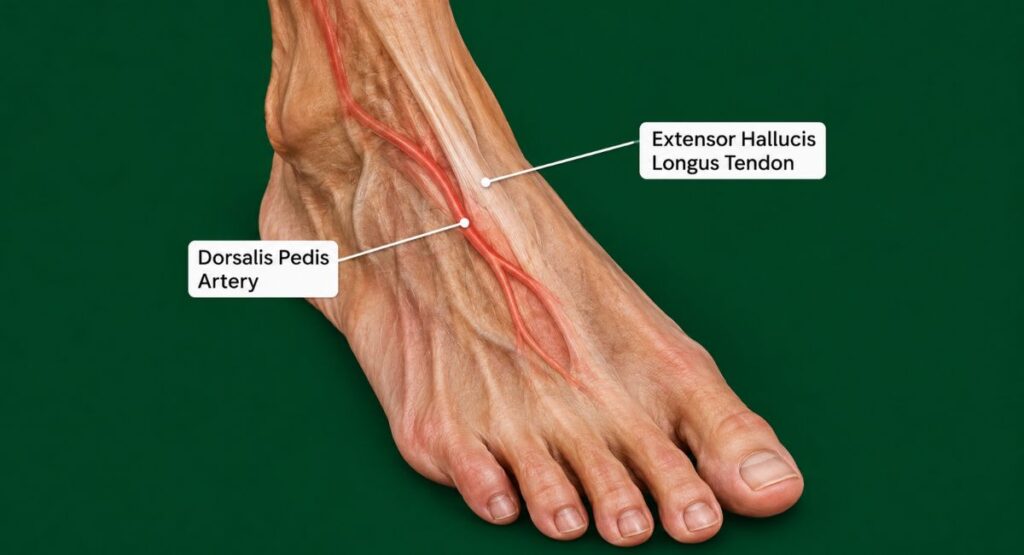
The dorsalis pedis pulse is located on the upper surface of the foot, where the dorsalis pedis artery passes across the dorsal region. It is commonly examined near the tendon that extends the big toe, usually just towards the outer side of that tendon.
The dorsalis pedis artery is a continuation of the anterior tibial artery after it passes across the front of the ankle. Understanding its anatomical position helps explain where the pulse is generally examined and why its exact location can differ between individuals.
Where Is the Dorsalis Pedis Pulse Located?
The dorsalis pedis pulse is found on the dorsal (upper) surface of the foot.
Its commonly described location is near the extensor hallucis longus tendon, which is responsible for extending the big toe.
The artery generally runs just lateral to this tendon, meaning towards the little-toe side of the foot.
However, the exact position of the artery is not identical in everyone. Anatomical variations can affect its course and branching pattern.
How to Find the Dorsalis Pedis Pulse
The general anatomical landmarks used to locate the dorsalis pedis pulse are:
- Look at the upper surface of the foot, near the ankle.
- Identify the tendon connected to the big toe. This becomes more noticeable when the big toe is extended.
- Look just towards the outer side of this tendon.
- This region corresponds to the commonly described location of the dorsalis pedis artery.
The pulse is generally examined using gentle fingertip palpation.
The anatomical landmark provides a starting point for understanding its location, but the artery may follow a different course because of natural anatomical variation.
Understanding the Dorsalis Pedis Artery
The dorsalis pedis artery is an important artery of the foot.
It is generally described as the continuation of the anterior tibial artery beyond the ankle joint. It travels across the dorsal surface of the foot and gives off branches that contribute to the arterial supply of the foot.
Its anatomical course is important in understanding the location of the dorsalis pedis pulse.
The artery’s position and branching pattern may vary between individuals. Therefore, anatomical illustrations usually represent a typical arrangement rather than every possible variation.
What Does Scientific Research Say About Its Location?
Anatomical research and clinical examination literature describe the dorsalis pedis artery as a vessel running across the upper surface of the foot.
The relationship between the artery and the extensor hallucis longus tendon is an important surface landmark used to understand its usual location.
However, research into arterial anatomy also highlights the importance of individual anatomical differences.
Three aspects are particularly relevant:
- Arterial course: The usual anatomical pathway helps explain where the pulse is commonly examined.
- Anatomical variation: Differences in the artery’s origin, position and branching can affect its location.
- Pulse palpation: The ability to feel the pulse does not necessarily depend on one fixed anatomical point.
These anatomical findings should not be confused with evidence about the diagnostic accuracy of pulse examination. Establishing the artery’s anatomical course and evaluating its clinical usefulness are different research questions.
Dorsalis Pedis vs Pedal Pulse: Are They the Same?
The terms dorsalis pedis pulse and pedal pulse are related, but they do not always mean exactly the same thing.
The dorsalis pedis pulse specifically refers to the pulsation associated with the dorsalis pedis artery on the upper surface of the foot.
Pedal pulse is a broader clinical term used for arterial pulses examined in the foot. It commonly includes:
- Dorsalis pedis pulse: Examined on the upper surface of the foot.
- Posterior tibial pulse: Examined near the inner side of the ankle, behind the medial malleolus.
Therefore, the dorsalis pedis pulse is one type of pedal pulse.
Understanding this distinction helps avoid confusion when reading anatomical and clinical examination literature.
Why Can the Dorsalis Pedis Pulse Be Difficult to Locate?
The dorsalis pedis artery does not follow an identical course in every individual.
Anatomical variation is one reason why its pulse may not always be easy to identify at the commonly described location.
Other factors can also influence how easily a pulse can be felt, including the conditions of examination and individual anatomical differences.
Importantly, a pulse that is difficult to palpate does not, by itself, establish the presence of an arterial condition. Pulse palpation findings should not be interpreted as a standalone diagnosis.
What Does the Research Not Establish?
Understanding the anatomical location of the dorsalis pedis artery does not establish that:
- Its position is identical in everyone.
- A difficult-to-palpate pulse always indicates a circulation problem.
- A palpable pulse guarantees that all aspects of foot circulation are normal.
- The dorsalis pedis pulse and posterior tibial pulse are interchangeable anatomical structures.
These distinctions are important when interpreting anatomical research and clinical examination information.
Conclusion
The dorsalis pedis pulse is generally located on the upper surface of the foot, near the extensor hallucis longus tendon and towards its outer side.
It is associated with the dorsalis pedis artery, which continues from the anterior tibial artery beyond the ankle.
Although this is the commonly described anatomical location, individual variations can affect the artery’s exact course. Understanding these anatomical differences provides a more accurate picture of the dorsalis pedis pulse and its relationship to other pedal pulses.
References and Further Reading
- BackTable. Dorsalis Pedis Pulse.
https://www.backtable.com/shows/vi/articles/dorsalis-pedis-pulse - Physiopedia. Dorsalis Pedis Artery.
https://www.physio-pedia.com/Dorsalis_Pedis_Artery - National Library of Medicine. PubMed record, PMID: 12509693.
https://pubmed.ncbi.nlm.nih.gov/12509693/ - VH Dissector. Dorsalis Pedis Pulse – Surface Palpation Guide.
https://www.vhdissector.com/lessons/surface-palpation-guide/ankle_foot/other/dorsalis_pedis_pulse.html - Osmosis. Dorsalis Pedis Artery.
https://www.osmosis.org/answers/dorsalis-pedis-artery
Disclaimer: This article is intended for general educational and informational purposes only. It explains the anatomy and location of the dorsalis pedis pulse and should not be considered medical advice, diagnosis or a substitute for professional medical evaluation. The artery’s anatomical position and pulse examination findings may vary between individuals. Always consult a qualified healthcare professional for concerns about your health or circulation.