
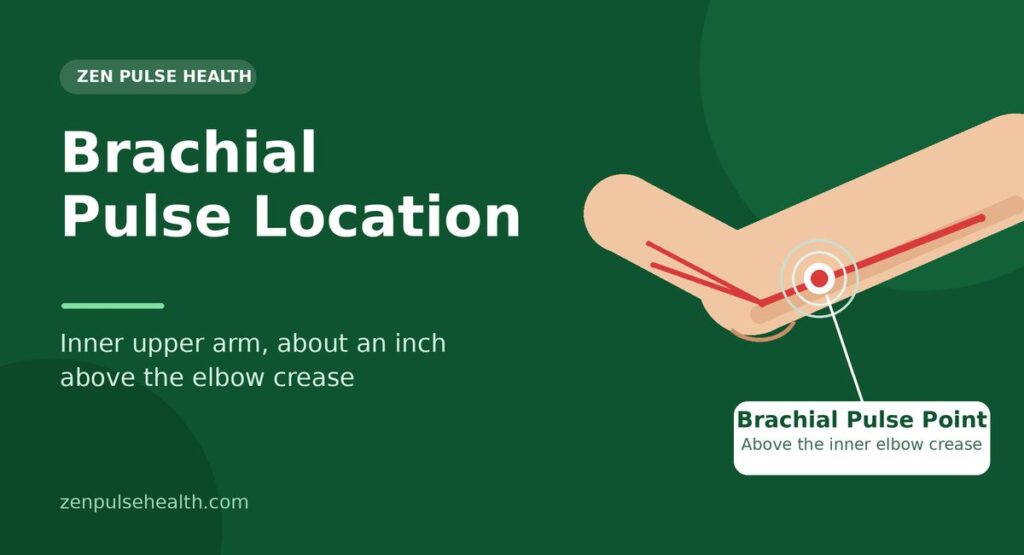
The Brachial Pulse Location is on the inside of the upper arm, near the elbow crease. It is where the brachial artery passes through the arm and can be felt with gentle pressure. Knowing where this pulse is located can help you understand basic body anatomy and the different pulse points found around the body.
In this guide, we’ll cover where the brachial artery sits, how to find it, and why healthcare professionals rely on it. This article is for learning only and is not a substitute for medical advice.
What Is the Brachial Pulse?
Your heart pumps blood with every beat, and that push travels through your arteries. When an artery lies close to the skin, you can feel it as a gentle throb. That is your pulse, and the spots where it is easy to feel are often called pulse points.
The brachial pulse comes from the brachial artery. This artery supplies oxygen-rich blood to your upper arm, starting just below the shoulder and running down to the crease of your inner elbow. At the elbow it splits into two smaller arteries, the radial and the ulnar, which carry blood to your forearm and hand. You have one in each arm.
Where Is the Brachial Pulse Located?
Here is the simple answer for voice search: the brachial pulse can be felt on the inside of the arm, in the groove between the biceps muscle and the triceps, about an inch above the elbow crease.
Doctors describe it in anatomical terms. The brachial artery can be palpated just above the antecubital fossa, between the medial epicondyle of the humerus and the tendon of the biceps. In everyday words, that is the soft inner part of your elbow, slightly toward the body side of your arm.
How to Find Your Brachial Pulse (Step by Step)
You don’t need any special tools. Try this at home to understand how it feels:
- Sit comfortably. Rest your arm on a table or your lap with the palm facing up. A supported, relaxed arm makes the pulse easier to feel.
- Locate the inner elbow crease. Slide your fingers about an inch up from the crease on the inner side of your arm.
- Use two or three fingertips. Place the pads of your index and middle fingers in the groove next to the biceps. Using your fingers instead of your thumb helps you avoid mixing it up with your own thumb pulse.
- Press gently. Light to moderate pressure is enough. If you press too hard, you can block a weak pulse. If you press too softly, you may miss it.
- Count the beats. Watch a clock for 30 seconds, count the beats, and multiply by two for beats per minute. A longer count gives a more accurate number, especially if your rhythm feels uneven.
If you can’t feel anything at first, don’t worry. Shift your fingers slightly, relax your arm, and try again. Cold hands can make a pulse feel fainter, so warm your arm first. Many people find the wrist easier when they are just starting out, and our guide on the Radial Pulse Location walks through that spot step by step.
Why Is the Brachial Pulse Important?
The brachial artery has a few important jobs in healthcare:
- Blood pressure checks. The cuff wrapped around your upper arm measures the blood pressure in your brachial artery.
- Infant pulse checks. The brachial pulse is often checked during infant resuscitation. A baby’s neck is short and chubby, so the upper arm is an easier place to feel a pulse. For adults, the neck is usually preferred in emergencies, which is explained in our article on the Carotid Pulse Location.
- Ankle-brachial index test. Providers compare the pressure in the arm with the pressure in the ankle to look for blockages in leg arteries.
A Real-World Study: How Hard Is It to Feel a Pulse?
Feeling a pulse sounds easy, but it is a skill that takes practice, even for trained professionals. A study by Tibballs and Weeranatna, published in the journal Resuscitation in 2010, shows this clearly.
In the study, doctors and nurses were blinded to the monitors and asked to feel for a brachial pulse in 17 children whose circulation was supported by a machine that produced no pulse. Rescuers who decided quickly, in under 10 seconds, were about 90 percent accurate, but accuracy dropped to about 62.5 percent for those who took 21 to 30 seconds. Experienced staff were also faster than less experienced ones.
An earlier study by the same research group found a similar pattern: brachial palpation was slightly more reliable than femoral palpation, yet checking a pulse by touch alone was still considered unreliable for diagnosing cardiac arrest in children.
What this means for you: a pulse check is a helpful skill, but it isn’t perfect. That is why professionals also use other tools, and why you should never rely only on a finger check in a real emergency.
Final Thoughts
The brachial pulse location is easy to remember: inside the arm, just above the elbow bend. With a little practice, a gentle touch, and a calm arm, most people can find it. Remember that this skill is for learning and awareness, not for diagnosing any condition.
Disclaimer: This article is for educational purposes only and does not replace professional medical advice, diagnosis, or treatment.
References
- Cleveland Clinic – Brachial Artery
https://my.clevelandclinic.org/health/body/22193-brachial-artery - NCBI Bookshelf – Anatomy and related clinical information
https://www.ncbi.nlm.nih.gov/books/NBK542175/ - WikiHow – How to Find Your Brachial Pulse
https://www.wikihow.com/Find-Your-Brachial-Pulse