
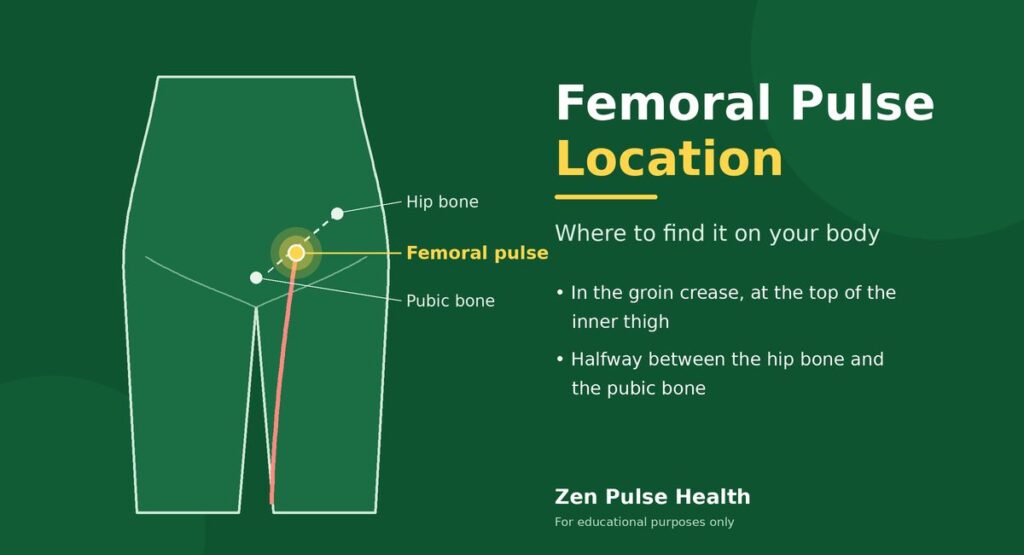
The Femoral Pulse Location is in the groin area, where the femoral artery passes through the upper part of the thigh. The femoral pulse is commonly checked by gently feeling this artery with the fingertips. Knowing where it is located can help readers understand basic pulse points and the anatomy of blood flow in the lower limb.
Where Is the Femoral Pulse Located?
The femoral pulse can be felt in the groin crease, where the upper thigh meets the lower abdomen. It is located over the femoral artery, a major blood vessel that carries oxygen-rich blood from the pelvis into the leg.
A simple way to locate it is to place your fingertips in the crease between the abdomen and upper thigh. The pulse is generally felt slightly toward the middle of the groin rather than on the outer side of the thigh.
The exact position can vary slightly from person to person because of differences in body structure and the amount of tissue over the artery.
How to Find the Femoral Pulse
The femoral artery travels through an anatomical area called the femoral triangle. This region is located at the upper front of the thigh and contains important blood vessels and nerves.
To understand the general location:
- Sit or lie in a comfortable position with the leg relaxed.
- Find the crease where your thigh meets your lower abdomen.
- Place two or three fingertips gently in the central part of the groin crease.
- Apply light, steady pressure until you feel a rhythmic pulsing sensation.
Avoid using your thumb because it has its own pulse, which can make the pulse harder to identify.
The femoral pulse may be easier to feel when the leg is relaxed. Pressing too hard can also make the pulse more difficult to detect.
Why Is the Femoral Pulse Important?
The femoral artery is one of the body’s major arteries. It continues from the external iliac artery and supplies blood to much of the lower limb.
Because of its location and size, the femoral pulse can provide useful information about blood flow through the leg. In clinical settings, healthcare professionals may check pulses at different points on the body when assessing circulation.
The femoral pulse is also one of several major pulse points. Other commonly discussed locations include the wrist, neck, and upper arm. For example, the Brachial Pulse Location is found in the upper arm, while the femoral pulse is located near the groin.
You can also learn more about different areas of the body where a pulse may be felt in this guide to Pulse Points.
Femoral Artery and Femoral Triangle
Understanding the femoral pulse location becomes easier when you know a little about the femoral triangle.
The femoral triangle is a triangular-shaped area at the upper front of the thigh. It contains important structures, including the femoral artery, femoral vein, and femoral nerve.
The femoral artery enters this region beneath the inguinal ligament and continues down the thigh. As it travels farther down the leg, it eventually becomes the popliteal artery behind the knee.
Because the femoral artery is relatively large and positioned close to the surface in the upper thigh, its pulse can often be detected through the skin.
Femoral Pulse vs. Other Pulse Points
The femoral pulse is different from pulses felt at other locations because it represents blood flow through a major artery supplying the lower limb.
For example:
- Carotid pulse: Felt on the side of the neck.
- Brachial pulse: Felt in the upper arm near the elbow region.
- Radial pulse: Commonly felt at the wrist.
- Femoral pulse: Felt in the groin area.
- Popliteal pulse: Located behind the knee.
- Dorsalis pedis pulse: Felt on the top of the foot.
These pulse points follow the pathway of major arteries throughout the body.
What Can Affect the Femoral Pulse?
The ability to feel a femoral pulse can vary depending on several factors. Body structure, the position of the leg, the amount of tissue over the artery, and the amount of pressure used when checking the area can all affect how easily the pulse can be detected.
A pulse that is difficult for a person to feel on their own does not automatically indicate a health problem. Pulse assessment is more meaningful when performed as part of an appropriate clinical examination.
For this reason, people should not use the presence or absence of a pulse by itself to diagnose a circulation problem.
Clinical Importance of the Femoral Artery
Healthcare professionals may assess the femoral artery and its pulse when examining circulation in the lower limbs. The artery is also an important anatomical structure in several medical procedures because of its size and accessibility.
Research and clinical literature have described the importance of femoral vascular anatomy in different medical settings. Anatomical references such as Cleveland Clinic and TeachMeAnatomy provide detailed information about the femoral artery and femoral triangle.
A published case report available through PubMed Central (PMC) also provides a clinical example involving femoral vascular anatomy and demonstrates why understanding this region is important in healthcare practice. The full publication can be reviewed for the specific clinical details.
When Should You Seek Medical Attention?
A person should not try to diagnose a circulation problem simply by checking their femoral pulse at home.
If someone has sudden or significant symptoms involving a leg, such as severe pain, unusual coldness, marked color changes, numbness, weakness, or other concerning symptoms, medical evaluation is appropriate.
A healthcare professional can assess circulation properly using a physical examination and, when needed, additional tests.
Frequently Asked Question
Where exactly is the femoral pulse located?
The femoral pulse is generally found in the groin crease, where the upper thigh meets the lower abdomen. It can usually be felt over the femoral artery in the upper front portion of the thigh.
Is the femoral pulse normally easy to feel?
It can be felt in many people, but how easily it can be detected varies with body structure, positioning, and the pressure used. Difficulty feeling it does not by itself establish that there is a circulation problem.
Which artery produces the femoral pulse?
The femoral pulse comes from the femoral artery, a major artery that carries blood into the lower limb.
References
- Cleveland Clinic – Femoral Artery:
https://my.clevelandclinic.org/health/body/21645-femoral-artery - TeachMeAnatomy – Femoral Triangle:
https://teachmeanatomy.info/lower-limb/areas/femoral-triangle/ - PubMed Central – Clinical Research/Case Report:
https://pmc.ncbi.nlm.nih.gov/articles/PMC12032564/ - ScienceDirect – Femoral Vascular Research:
https://www.sciencedirect.com/science/article/abs/pii/S0883540305800749